Designed for
continuous targeted
pain relief.
Targeted. Continuous.
Convenient.
The RrhoidCath™ design enables minimal trauma on insertion, targeted placement of the catheters and retention in an optimal position. This allows for continuous targeted local anaesthetic to the surgical site after haemorrhoidectomy, to improve pain relief during recovery and reduce the need for opioids.
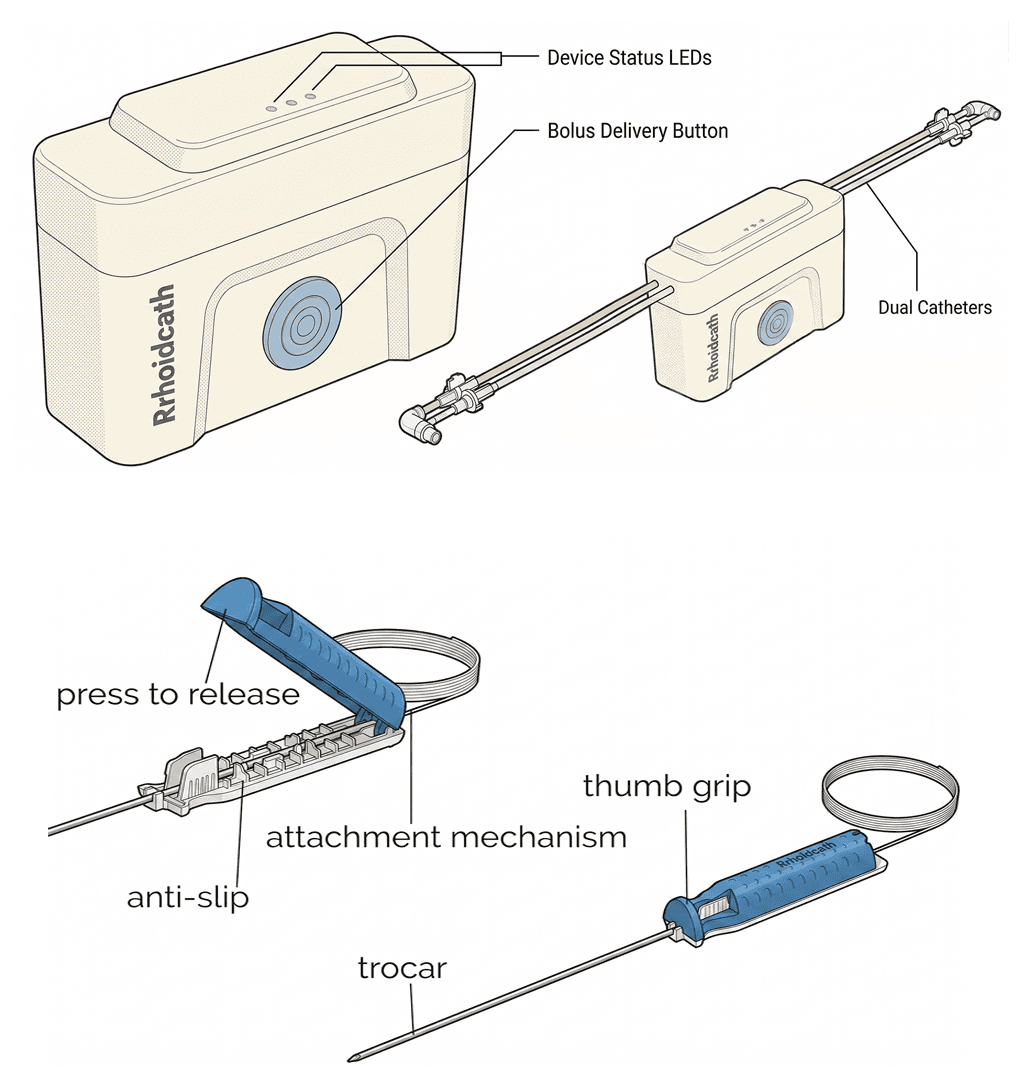
The RrhoidCath™ system includes a nerve probe, two infusion catheters, tunnelling trocars, and a programmable pump. Together they enable the continuous delivery of a local anaesthetic to the wound site for up to seven days. Dosing limits are set by the physician, with an optional patient-triggered bolus for activity peaks such as bowel movements.
Engineered to do one job, exceptionally well.
Key Components
- Insertion deviceSpecially designed for nerve localisation and accurate placement of the infusion catheters.
- TunnellersSlim trocars used to route the catheters to an exit site over the hip region, away from the perineal area.
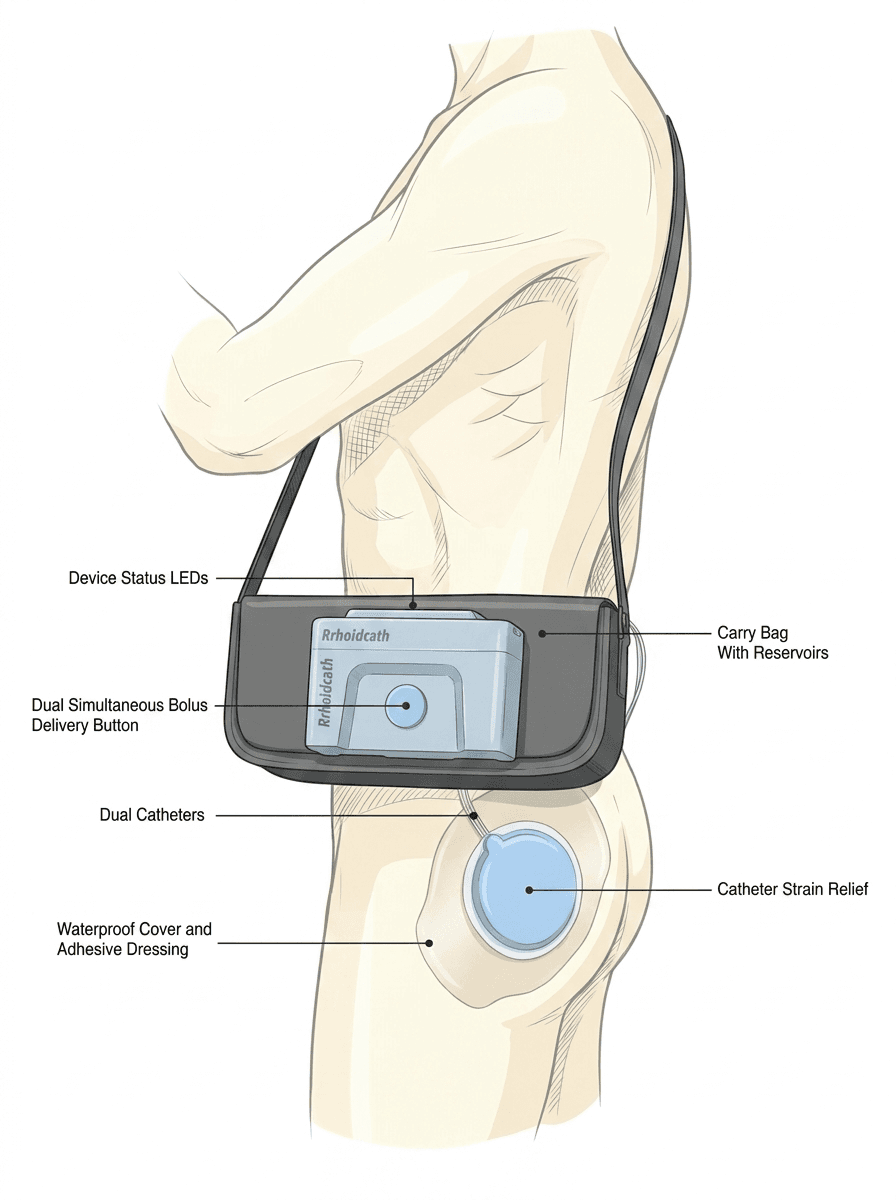
- Strain reliefAdhesive covers retain the catheters in position, protecting against movement or accidental removal.
- Programmable pumpFilled with local anaesthetic during the operation and programmed to meet each patient's dosing needs.
Frequently Asked
Questions.
How does RrhoidCath™ deliver pain relief after haemorrhoidectomy?
RrhoidCath™ delivers a continuous infusion of local anaesthetic to the surgical site through two catheters placed adjacent to the pudendal nerve branches during the haemorrhoidectomy. The catheters tunnel under the skin to exit points over the hip region, where they connect to an infusion pump carried in a shoulder bag that runs continuously for up to seven days.
How is the catheter placed during haemorrhoidectomy surgery?
The catheter is inserted in theatre through an introducer that incorporates an insulated electrode. Nerve stimulation through the electrode allows accurate localisation of the pudendal nerve branches before the infusion catheter is deployed bilaterally. The catheters are then tunnelled under the skin using slim trocars to exit at gluteal points away from the perineal area.
How long does the RrhoidCath™ system stay in place?
The system is worn by the patient for up to seven days following the haemorrhoidectomy procedure.
Where does the device sit on the body during the wear period?
The catheters exit at gluteal points over the hip region, well away from the perineal area for patient comfort. The infusion pump is placed in an over-the-shoulder bag that can be carried conveniently.
How is the RrhoidCath™ device removed?
At the end of the treatment period, the catheter and pump are removed non-surgically in a post-op visit.